

Helix Live Brain™
A living-world intelligence layer, enabling responsive worlds, evolving characters, and dynamic interaction over time.
What is Helix?
Helix is an AI-assisted runtime for living worlds - an orchestration layer that enables characters and worlds to respond and evolve over time.
Helix does not “write” games.
It operates between human-authored intent - characters, arcs, tone, memories, and rules - the evolving game state that tracks what has happened, and AI-extended delivery inside a living world.
Most AI in games echo like a reflection.
Helix thinks like a brain.
While Helix was developed alongside Of Moss & Moonlight, it is designed to run across engines and power any living world experience.
Helix does not confer social license. It does ensure living world AI remains bounded, observable, and manageable over time. It preserves authored boundaries, enables studio-defined tuning, and supports accountability through traceability and intervention pathways.
Live Helix Behavior (In-Engine)
These conversations were generated dynamically at runtime, shaped by character state, memory, and emotional context - not pre-authored dialogue or direction.
The same moment produces different responses depending on the character’s connection to the player. This is not branching dialogue. It is Helix generating behavior in context.
Helix is Not...
... a Chatbot. Better lighting doesn't make a chatbot a living world.
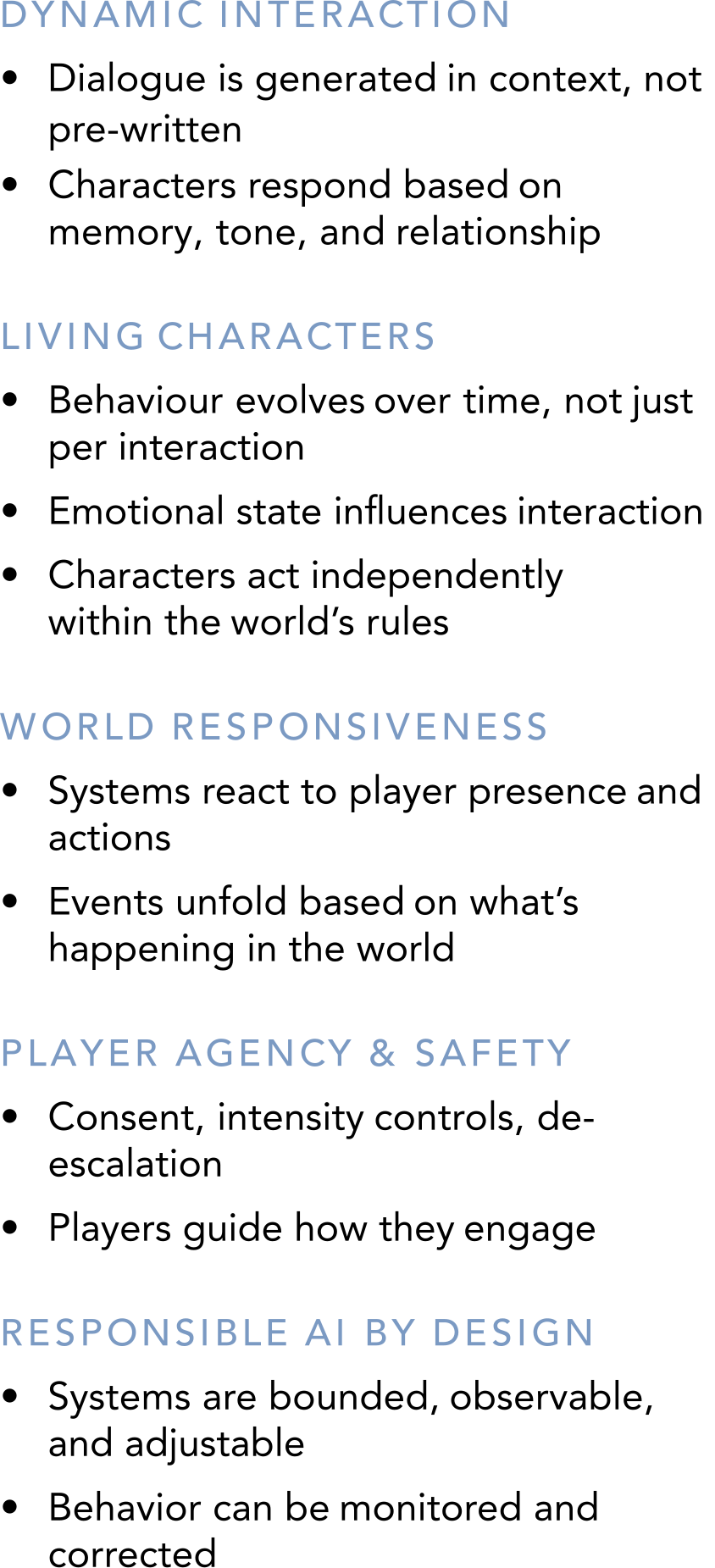
Characters respond in context - anchored in the world, their identity, what’s happened, and their relationships.
Players aren’t limited to fixed dialogue options - interaction is dynamic.
... AI-controlled gameplay or unchecked systems. A world only works if it's designed to.
Studios design the world. Helix enables it to play out dynamically - it doesn’t replace it. Boundaries and safeguards are built in, so behavior stays within the rules. Studios can step in to correct it, and players control how they engage.
... just integration. Connecting systems isn’t the same as making them behave as one.
Connecting systems isn’t the same as making them work as one. Helix orchestrates how AI, game systems, and state interact - so the world holds together over time.
... a black-box or locked platform. If you can’t see or change it, you don’t control it.
What’s happening under the hood can be observed, tuned, and corrected - it’s not opaque. Studios can choose different AI systems for different purposes. If something isn’t working, they’re not tied to it - they can swap, change, or replace parts of the system.
... irresponsible AI. AI should support and extend games - not overwrite them.
Responsible AI is built into how Helix works - from how it’s structured, to how it behaves, and how both studios and players can see, guide, and adjust it over time.
Why Helix Exists
AI was the last thing on our minds when we started building Of Moss & Moonlight.
We had a vision for a magical, realistic, beautiful game - one that still felt exciting well after the first time you played. As we built that world, we began using AI in small, practical ways. When we fed a character’s lore into a model, it was striking how quickly it picked up how they should sound. A few corrections, and it was right.
That was the moment the penny dropped.
The kind of living experience we wanted - where characters didn’t repeat the same lines, where they could remember, adapt, and respond over time without breaking tone, story, or themselves - couldn’t be delivered with manual tools alone.
When we looked at what existed, nothing met our requirements for capability, human authorial control, player consent and safety, and long-term responsibility. So we built Helix.
The double strand in the Helix mark reflects the system itself - authored intent and AI capability running side by side, converging with game state to produce something no single part could achieve alone.